
In the world of Go-To-Market, we obsess over line items. We audit software seat costs, scrutinise ad spend, and haggle over platform fees. But there is a silent, invisible tax draining your revenue every single day, and it doesn’t show up on a P&L statement.
It isn’t your tech stack. It’s human delay.
The Anatomy of the “Delay Tax”
When a prospect shows intent, a pricing page visit, a heavy spike in product usage, or a high-value content download, the clock starts ticking. In a perfect world, that signal would lead to an immediate, relevant conversation.
In reality, most GTM motions are a series of manual hurdles:
-
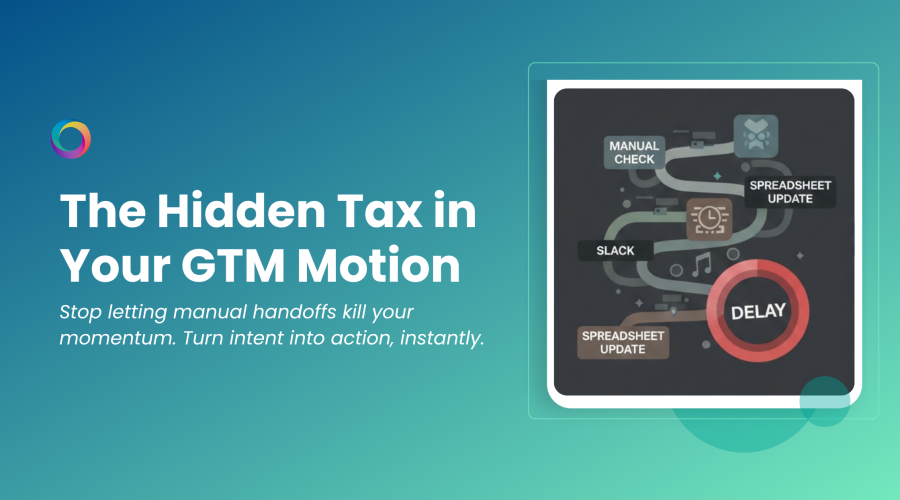
The Observation Phase: Someone has to manually check a dashboard or “see” an email notification.
-
The Coordination Phase: A Slack message is sent to a channel. “Hey @Sales-Team, is anyone owning this account?”
-
The Administrative Phase: A CRM record is updated, or worse, a spreadsheet is modified to track the lead source.
-
The “Hope” Phase: A manager says, “Someone should probably follow up on this,” and then everyone goes to lunch.
While your team is busy navigating internal handoffs and manual data entry, the buyer hasn’t stopped. They’ve moved on to a competitor who was ready to talk now.
Why Momentum is Your Most Fragile Asset
In B2B buying, momentum is non-linear. A buyer’s interest peaks the moment they are engaging with your brand. Every hour that passes without a response isn’t just a delay; it’s a decay in deal value.
When you rely on human memory or manual handoffs, you are essentially betting your revenue on your team never being “too busy” to notice a signal. That is a losing bet. High-performing GTM teams have realised that speed isn’t a by product of effort, it’s a result of architecture.
The Shift: From Reactive to Automated
To stop paying the “human delay tax,” organisations must transition from a reactive posture to an automated execution model.
| The Old Way: Reactive | The New Way: Signal-Led |
| Ignored Alerts: Noisy notifications that lead to “alert fatigue.” | Triggered Workflows: Signals automatically stage an email or create a prioritised task. |
| Manual Handoffs: Work sits in a queue waiting for a human to route it. | Automated Routing: Lead-to-account matching and routing happen in milliseconds. |
| Delayed Action: Follow-up happens 24–48 hours later. | Instant Engagement: The moment a signal appears, the motion begins. |
Designing a “Zero-Delay” System
The goal is to build a system where the software handles the logistics so your people can handle the relationships. A “Zero-Delay” GTM motion means that when a high-intent signal is captured:
-
The right owner is notified with context (not just a link).
-
The CRM is updated via automation, not manual entry.
-
The next step (a call, a personalised video, or an invite) is teed up and ready for one-click execution.
The Bottom Line
Stop asking your team to work harder and start asking your systems to work faster. When you remove the friction of manual coordination, speed becomes your greatest competitive advantage. In 2026, the winner isn’t just the one with the best product—it’s the one who acts the moment the buyer is ready.
📈 Keep your pipeline full, and protected.
Try Zymplify’s GTM Agent free and see how early intent detection can save and grow your revenue → https://d36.co/1bV1m