
Every business begins with a set of “best practices” that feel like gospel. You hire talented people, give them a playbook, and expect results to grow linearly with your headcount.
But then, the volume increases.
Suddenly, the processes that got you to £5M ARR start to feel like anchors at £20M. You haven’t hired the wrong people, and your strategy hasn’t changed. The problem is simple: Decision-making doesn’t scale.
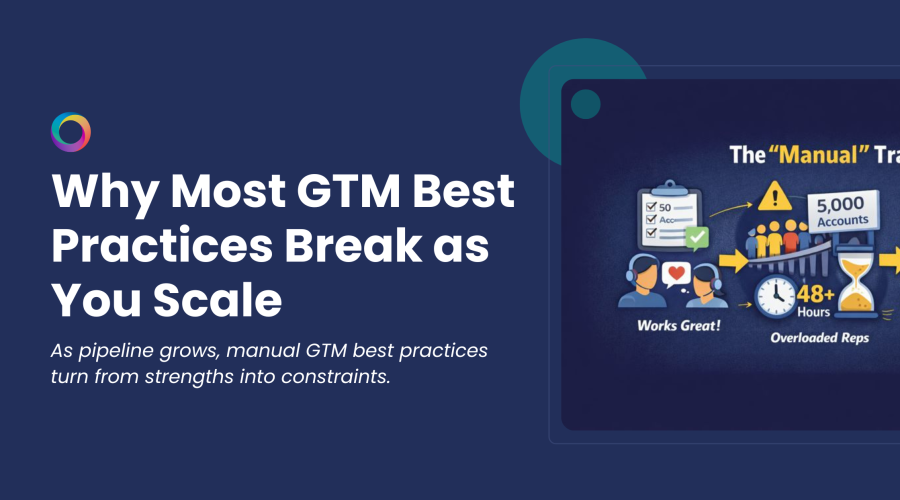
The “Manual” Trap
Most GTM advice works perfectly… until it doesn’t.
-
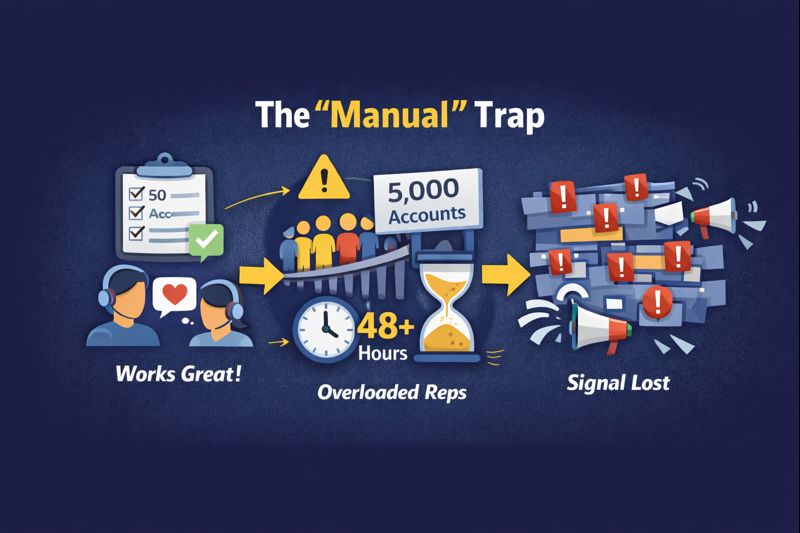
Manual qualification is brilliant when you have 50 accounts to monitor.
-
Bespoke, personalised outreach is effective when your reps have hours to spare.
-
Team alignment is easy when everyone is in the same room, or at least the same Slack channel, and remembers the next step.
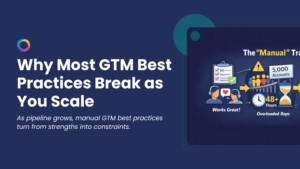
But as pipeline grows, these manual “best practices” become bottlenecks. When you move from 50 accounts to 5,000, cracks appear. High-intent accounts sit in queues for 48 hours. Reps get overwhelmed and default to the easiest leads rather than the most valuable ones. Low-priority noise starts to drown out the signal.
The Decision-Making Bottleneck
The common reaction to these “cracks” is to tell the team to “execute harder.” We add more meetings, more CRM fields, and more management layers.
But high-performing teams don’t try to out-hustle the volume. They remove decisions from the critical path.
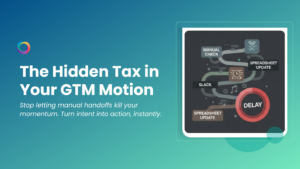
In a small team, a rep has to decide: “Who should I call today?” In a scaling team, that decision is a tax. If a rep has to spend 30 minutes every morning deciding where to start, you’ve already lost a significant chunk of their day to administrative friction.
The Shift: From “Best Practice” to “Operational GTM”
Scaling successfully requires a fundamental shift in how your GTM engine operates. You have to move from playbooks that live in slide decks to workflows that live in your tech stack.
| Instead of… | The System Does… |
| Asking “Who follows up?” | The system routes the lead based on pre-set logic. |
| Reps choosing when to act | Real-time buyer behaviour triggers a prioritised task. |
| Reading a PDF playbook | The workflow runs automatically in the background. |
Designing for the “Critical Path”
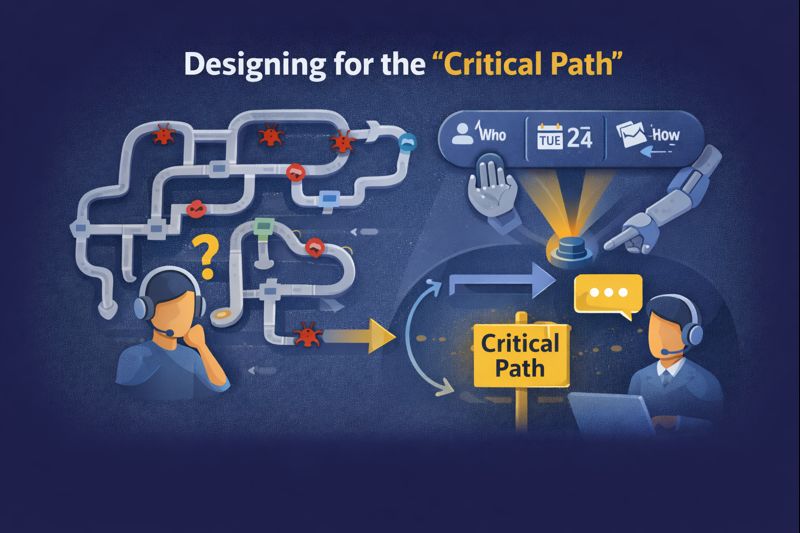
To win at scale, you must treat your GTM motion like a product. You are looking for “bugs” in the buyer journey, places where a human has to stop, think, and coordinate. Every time a human has to make a logistical decision, there is a chance for a delay.
Operational GTM is about building a system where the “right” action is the path of least resistance. When the system decides the “who, when, and how,” your reps are free to focus on the only thing that actually moves the needle: the conversation.
The Bottom Line
If your growth is stalling despite a talented team, stop looking at your people and start looking at your path. Don’t ask your team to work harder; build a system that makes it impossible for them to work slowly.
📈 Keep your pipeline full, and protected.
Try Zymplify’s GTM Agent free and see how early intent detection can save and grow your revenue → https://d36.co/1bV1m